Karl Johan-monumentet
Back to all places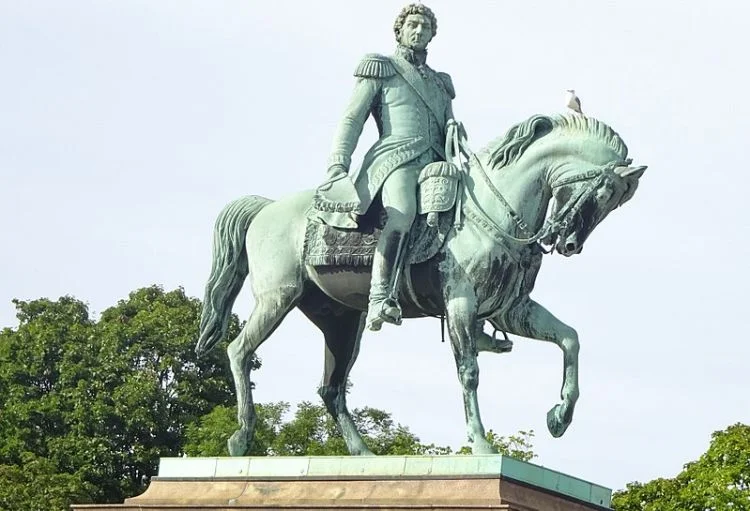
Karl Johan-monumentet
0:00 / 2:32Karl Johan-monumentet
The "Karl Johan monument" is an equestrian statue of the Swedish-Norwegian king Karl III Johan on Slottsplassen in Oslo. The statue, which stands in front of the Castle looking towards Karl Johans gate , was made by Brynjulf Bergslien. It was unveiled on 7 September 1875, on the day 57 years after Karl Johan was crowned in Nidaros Cathedral (1818).
The statue, which is in bronze, shows Karl Johan in a Swedish marshal ’s uniform with a sword suspended in the ribbon of the Order of Seraphim. The king wears the crest for the Seraphim Order as well as for the Knight of the Sword Order’s Grand Cross and around his neck the Order of Charles XIII. The horse has just stopped, and it stomps with its left foreleg, while the king salutes with his uniform hat, a two-nosed bicorn. On one side of the plinth, which is coarse-grained grefsen syenite from the Oslo field, is the inscription ""People’s love min belönning."". On the other side it says "The Norwegian people erected this memorial."
Already in the 1830s and 1840s, ideas had been floated about erecting a monument to Karl Johan, but it was only around the fiftieth anniversary of the union with Sweden in November 1864 that the plans gained momentum. The king -friendly Carl Johansforbund then started a collection for an equestrian statue. The proposal itself does not seem to have led to protests. However, there was heated debate about the appearance and which artist should get the commission. The monument became an important symbolic element in an ongoing political dispute about the revision of the union agreement.
The reigning monarch, Charles IV , was heavily involved. He wanted the monument to depict the king riding after the coronation ceremony, in order to emphasize the Bernadotte dynasty’s right to the Norwegian throne. (This despite the fact that Karl Johan did not actually leave the coronation on horseback.) He also wanted to place the statue in front of the Stortingsbygningen , which would clarify the royal position of power. By showing the king wearing a coronation robe, the idea was to link to the Norwegian medieval kings, - in military uniform, Karl Johan would be more likely to be seen as a conqueror.
Several artists created drafts for the Karl Johan monument. In June 1866, the French sculptor Louis Rochet came to Christiania with a draft. It showed the king in uniform and the horse at a slow trot. Both figures were criticized for being too lifelike.
https://no.wikipedia.org/wiki/Karl_Johan-monumentet
Photo: Paasikivi
59.91674, 10.72898